Journal of Food Science and Nutrition Therapy
Comparative Efficacy of 5-Hydroxytryptophan Delivered via Capsule or Functional Food Bar on Mood, Sleep, and Salivary Cortisol: A Randomised, Double-Blind, Placebo-Controlled Trial
1NURA USA LLC, Irvine, CA 92614, USA
2Department of Human Nutrition, Kansas State University, Manhattan, KS 66506, USA
3BioAgile Therapeutics Pvt. Ltd., RMV 2nd Stage, Dollars Colony, Bangalore 560094, INDIA
Author and article information
Cite this as
Venter RN, et al. Comparative Efficacy of 5-Hydroxytryptophan Delivered via Capsule or Functional Food Bar on Mood, Sleep, and Salivary Cortisol: A Randomised, Double-Blind, Placebo-Controlled Trial. J Food Sci Nutr The. 2026; 12(1): 1-8. Available from: 10.17352/jfsnt.000059
Copyright License
© 2026 Venter RN, et al. This is an open-access article distributed under the terms of the Creative Commons Attribution License, which permits unrestricted use, distribution, and reproduction in any medium, provided the original author and source are credited.Objective: Poor sleep quality and elevated psychological distress are highly prevalent in young adults. This randomised, double-blind, placebo-controlled, four-arm parallel group clinical trial evaluated the comparative efficacy of 5-hydroxytryptophan (5-HTP) derived from organic Griffonia simplicifolia delivered via a traditional capsule versus a functional food snack bar on mood, sleep quality, and physiological stress markers.
Methods: Eighty healthy adults aged 18-40 years with self-reported poor sleep quality and low mood were randomised in a 1:1:1:1 ratio to receive a Placebo Capsule, Placebo Bar, 5-HTP Capsule (150 mg/day), or 5-HTP Bar (150 mg/day) for 25 days. Outcomes included the Depression Anxiety Stress Scales-21 (DASS-21), the Pittsburgh Sleep Quality Index (PSQI), and salivary cortisol. Participants and all study personnel involved in conducting or evaluating the trial remained unaware of the treatment assignments. Efficacy was evaluated using an Intention-to-Treat (ITT) framework, with Last Observation Carried Forward (LOCF) used for missing follow-up data and ANCOVA models used to adjust for baseline values.
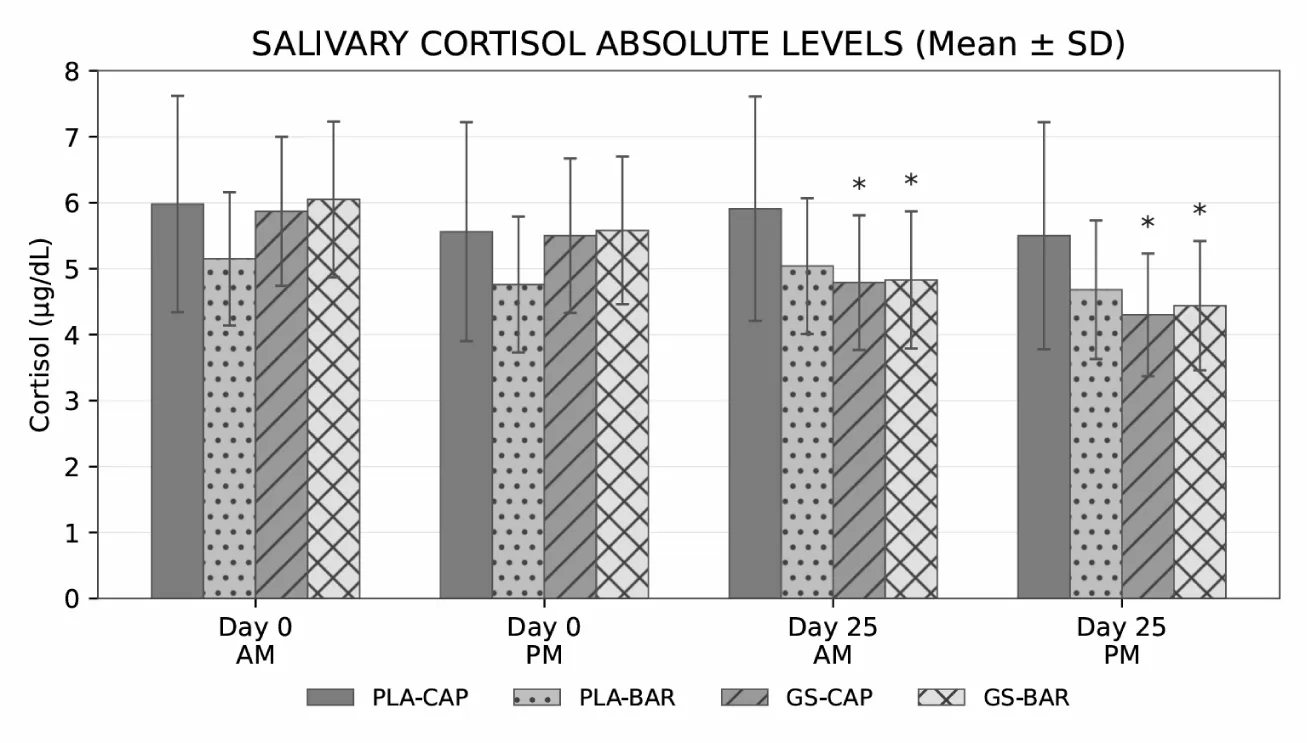
Results: Both active 5-HTP groups demonstrated improvements in DASS-21, PSQI, and salivary cortisol outcomes by Day 25. Placebo groups showed smaller mean changes from baseline: DASS-21 decreased by 2.35 points in PLA-CAP and 1.75 points in PLA-BAR, PSQI decreased by 1.60 points in each placebo group, and morning and evening cortisol changed by no more than 0.11 and 0.08 µg/dL, respectively. Baseline-adjusted ANCOVA models showed a significant overall treatment group effect. Supportive pairwise comparisons of the unadjusted Day 25 scores showed significant differences between each active 5-HTP group and its format-matched placebo group (p < 0.001). No statistically significant differences in clinical response were observed between the active capsule and functional food bar delivery formats for DASS-21 or PSQI outcomes.
Conclusions: Daily supplementation with 150 mg/day of 5-HTP is associated with significant improvement in mood and sleep quality in young adults, with supportive reductions in salivary cortisol. Under the conditions of this study, the functional food bar produced an observed clinical response comparable to the traditional capsule format. Trial registered with the Clinical Trials Registry-India (CTRI/2024/02/063100).
5-HTP: 5-hydroxytryptophan; DASS-21: Depression Anxiety Stress Scales-21; PSQI: Pittsburgh Sleep Quality Index; ITT: Intention-to-Treat or Intent-to-Treat; LOCF: Last Observation Carried Forward; ANCOVA: Analysis of Covariance; EMMs: Estimated Marginal Means; HSD: Honest Significant Difference; CRO: Contract Research Organization; HPA-axis: Hypothalamic-Pituitary-Adrenal Axis; APC: Article Processing Charge; CTRI: Clinical Trials Registry-India; PLA-CAP: Placebo Capsule; PLA-BAR: Placebo Bar; GS-CAP: Griffonia simplicifolia / 5-HTP Capsule; GS-BAR: Griffonia simplicifolia / 5-HTP Bar; SD: Standard Deviation; F/M: Female/Male.
Introduction
Growing attention is being directed toward how daily stress, emotional well-being, and sleep quality interact, particularly among young adults. Although depressive and anxiety symptoms are often evaluated as distinct outcomes, recent evidence among college-aged young adults indicates that these symptoms are closely related and commonly occur together [1]. Sleep disturbances commonly overlap with anxiety, and recent meta-analytic evidence indicates a high prevalence among individuals with generalised anxiety disorder. Longitudinal findings also suggest that shorter sleep duration may precede and contribute to increased perceived stress [2,3].
Recent mental health trends indicate increasing rates of anxiety and depressive symptoms among young adults, particularly college students [4,5]. These concerns may be further compounded by lifestyle and behavioural factors common in this age group, including high levels of social media use and associated sleep disturbance. Recent systematic review and meta-analytic evidence indicates that problematic social media use among young people is associated with sleep problems, depression, anxiety, and reduced well-being [6]. Sleep loss may also adversely affect emotional functioning and neuroendocrine stress responses; experimental sleep deprivation in healthy young adults has been shown to increase negative emotional states and alter morning cortisol concentrations [7]. These findings provide additional context for evaluating psychological outcomes and salivary cortisol as complementary measures in young adult populations.
Cortisol is the principal human glucocorticoid and a widely used physiological marker of hypothalamic-pituitary-adrenal (HPA) axis activity in response to psychosocial stress [8]. Its secretion is regulated through glucocorticoid negative-feedback mechanisms and follows a pronounced circadian rhythm, with concentrations generally highest around awakening and declining across the day. Dysregulation of the HPA axis may be reflected by alterations in cortisol concentration, diurnal slope, awakening response, or stress reactivity and has been investigated in relation to prolonged stress, depressive symptoms, and sleep disruption [9–11]. Because individual cortisol measures reflect different components of HPA-axis function, morning and evening salivary cortisol were evaluated as supportive physiological indicators rather than as stand-alone diagnostic markers of stress or mood disturbance.
5-Hydroxytryptophan (5-HTP) has been investigated as a nutraceutical approach for supporting mood and sleep. Griffonia simplicifolia is a medicinal plant native to West and Central Africa whose seeds are a rich natural source of 5-HTP [12,13]. 5-HTP is an intermediate metabolite in the conversion of L-tryptophan to serotonin and is converted to serotonin by aromatic L-amino acid decarboxylase. Unlike serotonin, which has limited ability to cross the blood-brain barrier, serotonin precursors such as 5-HTP can more readily access the central nervous system [14]. Serotonergic signalling contributes to the regulation of mood, appetite, circadian processes, and the sleep-wake cycle [14,15]. Consistent with this biological rationale, recent clinical evidence suggests that 5-HTP supplementation may improve selected sleep-quality outcomes, particularly among individuals with poor baseline sleep quality [16].
While dietary supplements are commonly administered in capsule form, functional foods, including nutrition bars, have also been evaluated as alternative delivery formats for bioactive ingredients [17,18]. This is particularly relevant for ingredients such as 5-HTP. Recent clinical studies have reported preliminary and mixed findings: one randomised trial observed improvement in depressive symptom scores following 5-HTP supplementation, whereas another placebo-controlled trial found no significant effects on depression, anxiety, or stress outcomes in a different clinical population [19,20]. These findings support continued investigation of 5-HTP as a mood-related bioactive and highlight the need for well-controlled studies in defined populations. Incorporation of bioactive compounds into complex food matrices may influence their stability, release, and bioavailability through interactions with matrix components and processing conditions [21].
Therefore, the present randomised, double-blind, placebo-controlled trial was designed to evaluate the comparative efficacy of 5-HTP derived from an organic Griffonia simplicifolia extract administered via a standard capsule versus a functional food bar on mood, sleep quality, and salivary cortisol in young adults.
Materials and methods
Study design and ethical approval
This study was a randomised, double-blind, placebo-controlled, four-arm parallel-group clinical trial conducted by BioAgile Therapeutics Pvt. Ltd. at Sri B.M. Patil Medical College Hospital, Vijayapura, Karnataka, India. A four-arm design was selected to allow each active delivery format to be compared with a format-matched placebo and to permit an exploratory comparison between the active capsule and functional food bar formats. A related analysis from the same clinical trial used matched capsule and snack bar formats, and recent randomised controlled studies have evaluated both functional snack bars as bioactive delivery systems and oral 5-HTP using placebo or control comparators [17,18]. One randomised trial reported a within-group reduction in depressive symptom scores at week 8, although the overall effect across time was not statistically significant, while another placebo-controlled trial found changes in depression, anxiety, and stress to be comparable between 5-HTP and placebo [19,20].
The study protocol was approved by the Institutional Ethics Committee on 29 January 2024 and was conducted in accordance with the Declaration of Helsinki. The trial was prospectively registered with the Clinical Trials Registry-India (CTRI/2024/02/063100). The present analysis was conducted as part of a broader clinical trial, with findings from the mushroom-extract intervention reported separately. This study addresses a distinct research question focused on the effects of 5-HTP supplementation and whether the observed outcomes differ by delivery format. Written informed consent was obtained from all participants before study initiation.
Participants and recruitment
Eighty healthy adults aged 18-40 years were enrolled and randomly assigned in a 1:1:1:1 ratio to one of four intervention groups (n = 20 per group): Placebo Capsule (PLA-CAP), Placebo Bar (PLA-BAR), 5-HTP Capsule (GS-CAP), or 5-HTP Bar (GS-BAR). Participants completed study visits at baseline (Day 0), mid-intervention (Day 13), and study completion (Day 25). Recruitment and enrollment were conducted at the clinical site by trained investigators. Final eligibility was confirmed by the Principal Investigator.
Inclusion and exclusion criteria
Inclusion criteria were adults who self-reported persistent mood- and sleep-related complaints for at least four weeks before screening. Participants were required to have a baseline Pittsburgh Sleep Quality Index (PSQI) score >5 and a raw baseline DASS-21 total score ≥18. The ≥18 threshold was prospectively specified in the study protocol as a study-specific eligibility criterion and was not intended to represent a diagnostic threshold or a conventional DASS-21 severity classification. Exclusion criteria included the current or recent use of antidepressants, anxiolytics, central nervous system depressants, or prescribed sleep medications.
Eligible participants were generally healthy adults aged 18-40 years without diagnosed chronic medical conditions and with symptoms such as difficulty initiating or maintaining sleep, non-restorative sleep, fatigue, irritability, nervousness, impaired concentration, or reduced motivation. Additional exclusion criteria included regular use of cannabis, tobacco, or vaping products; known allergy to 5-HTP or Griffonia simplicifolia; history of serotonin syndrome; diagnosed psychiatric disorders requiring pharmacologic treatment; diabetes or prediabetes; pregnancy or lactation; and any medical condition deemed by the Principal Investigator to interfere with study participation or interpretation of outcomes.
Intervention and study products
Participants consumed one assigned capsule or one 25 gram assigned bar portion twice daily (morning and evening) for 25 consecutive days, providing 150 mg/day of 5-HTP in each active group (Table 1).
Participants were instructed to avoid initiating new medications, supplements, or treatments during the study period. Compliance was monitored through returned product counts and field worker logs.
Randomisation, allocation concealment, and blinding
Participants were randomised using a block randomisation method with concealed block sizes to ensure allocation unpredictability. The randomisation sequence was computer-generated by an independent statistician affiliated with the contract research organisation (CRO). Allocation was implemented using sequentially numbered, sealed, opaque, tamper-proof envelopes, which were opened only after confirmation of eligibility.
The study followed a double-blind design. Participants, investigators, clinical staff, outcome assessors, and data analysts were blinded to treatment assignment throughout the study. Active and placebo capsules and snack bars were identical in appearance and packaging. Blinding was maintained until completion of data analysis and database lock, unless unblinding was required for safety reasons.
Outcome measures
Mood was assessed using the raw total score of the DASS-21 at baseline, Day 13, and Day 25 [22,23]. Sleep quality was assessed using the PSQI global score at baseline, Day 13, and Day 25 [24-26].
The DASS-21 comprises 21 items rated from 0 to 3 and includes three seven-item domains assessing depression, anxiety, and stress. In accordance with the prespecified analysis, responses across all 21 items were summed without multiplication to generate a continuous raw total score ranging from 0 to 63, with higher scores indicating greater overall psychological distress. The total score was used to evaluate changes in the aggregate burden of depression, anxiety, and stress-related symptoms over the intervention period and was not used to assign diagnostic status or conventional DASS-21 subscale severity classifications. Recent psychometric evidence supports a unidimensional general distress interpretation of the DASS-21 and reports strong internal consistency for the overall score [23].
Although the PSQI is traditionally framed as a one-month recall instrument, the 25-day intervention period was selected to capture recent habitual sleep patterns while aligning with commonly used 3-4 week durations in sleep intervention research.
For salivary cortisol collection, samples were obtained in the morning shortly after waking and in the evening prior to bedtime. Participants were instructed to avoid eating, drinking (except water), brushing teeth, or using oral hygiene products for at least 30 minutes before collection and to refrain from alcohol consumption and vigorous physical activity on collection days. Samples were analysed by the clinical laboratory associated with the CRO using a validated immunoassay method.
Safety assessments
Safety was assessed through monitoring of vital signs (oral temperature, heart rate, systolic and diastolic blood pressure), haematological parameters, and serum chemistry markers (alanine aminotransferase, aspartate aminotransferase, and creatinine). Physical and blood assessments were conducted at baseline (Day 0) and study completion (Day 25). Adverse events were monitored throughout the study using open-ended questioning and clinical observation.
Statistical analysis
All statistical analyses were performed using Python version 3.10, with Statsmodels version 0.14.0 used for ANCOVA and Tukey HSD comparisons and SciPy version 1.12.0 used for nonparametric analyses. Efficacy analyses were conducted using an Intention-to-Treat (ITT) framework, which included all randomised participants analysed according to their originally assigned groups. To account for participant attrition and support a complete ITT analysis, missing data at Day 13 or Day 25 were handled using the Last Observation Carried Forward (LOCF) imputation method.
Baseline-adjusted between-group analyses were conducted using Analysis of Covariance (ANCOVA). For each outcome, the Day 25 follow-up score was specified as the dependent variable, treatment group as the fixed factor, and the corresponding baseline value as the covariate. Estimated marginal means (EMMs) were used to summarise baseline-adjusted group outcomes. Tukey’s Honest Significant Difference test was conducted separately on the unadjusted Day 25 scores as a supportive analysis of pairwise group differences. The Tukey comparisons were therefore not derived from the ANCOVA-adjusted estimated marginal means. Statistical significance was set a priori at p < 0.05.
Within-group changes from baseline were evaluated as supportive analyses. Because several continuous variables did not consistently meet normality assumptions, nonparametric Wilcoxon signed-rank and Mann-Whitney U tests were retained as supportive analyses for within-group and pre-planned pairwise comparisons, respectively.
Results
Participant population, baseline characteristics, and covariate justification
A total of 80 randomised participants were included in the ITT efficacy analysis, with 20 participants assigned to each of the four treatment groups. Baseline demographic and anthropometric characteristics were generally comparable across groups, including sex distribution, age, height, and weight (Table 2).
Baseline clinical outcome values showed variability among groups for DASS-21, PSQI, and salivary cortisol measures (Table 3). Because baseline differences can influence post-intervention comparisons, between-group efficacy analyses were conducted using ANCOVA models with the corresponding baseline value included as a covariate. This approach allowed Day 25 outcomes to be compared across treatment groups after adjustment for baseline status.
Mood and sleep outcomes
DASS-21 and PSQI scores improved over the intervention period in both active 5-HTP groups. Reductions were observed by Day 13 and were more pronounced by Day 25, while placebo groups showed smaller changes (Table 3 and Figure 1). Lower DASS-21 and PSQI scores indicate improvement in psychological distress and sleep quality, respectively.
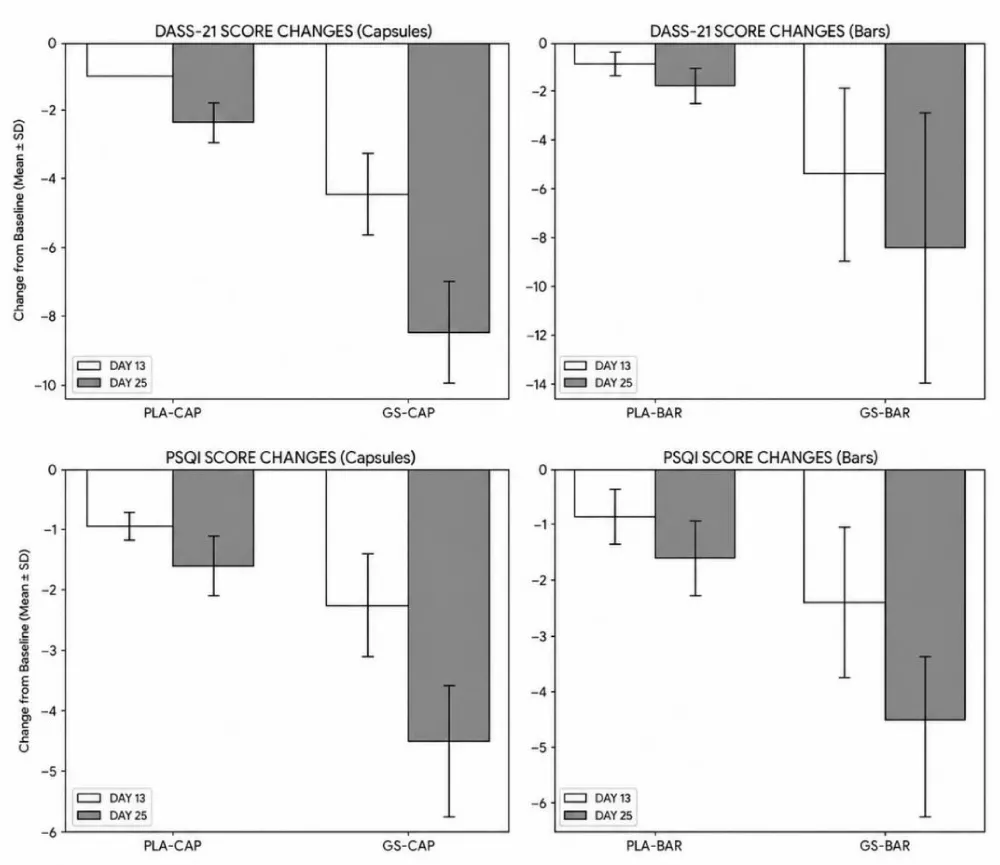
Baseline-adjusted ANCOVA demonstrated a significant overall treatment-group effect at Day 25 for both DASS-21 and PSQI. For DASS-21, adjusted estimated marginal means were 19.28 for GS-CAP and 19.73 for GS-BAR, compared with 25.33 for PLA-CAP and 25.31 for PLA-BAR. For PSQI, adjusted estimated marginal means were 6.52 for GS-CAP and 6.72 for GS-BAR. In supportive analyses of the unadjusted Day 25 scores, Tukey HSD comparisons showed significant differences between each active group and its format-matched placebo.
Salivary cortisol outcomes
Morning and evening salivary cortisol levels were evaluated at Baseline and Day 25. Both active intervention groups demonstrated reductions in salivary cortisol from Baseline to Day 25, while placebo groups showed minimal change (Table 3 and Figure 2). ANCOVA demonstrated a significant overall treatment-group effect for morning and evening cortisol after adjustment for baseline values. In supportive Tukey HSD comparisons of the unadjusted Day 25 values, both active groups had significantly lower morning and evening cortisol levels than their format-matched placebo groups (p < 0.001).
Matched placebo comparisons and delivery format evaluation
Supportive Tukey HSD comparisons of the unadjusted Day 25 scores showed significant differences between each active intervention and its respective placebo control across DASS-21, PSQI, morning salivary cortisol, and evening salivary cortisol outcomes (p < 0.001). These comparisons were conducted separately from the baseline-adjusted ANCOVA models. These findings indicate that 5-HTP delivered in either capsule or functional food bar format was associated with improved psychological distress, sleep quality, and salivary cortisol measures relative to matched placebo products.
Direct comparison of the two active delivery formats showed no statistically significant difference between GS-CAP and GS-BAR for reduction in psychological distress (p = 0.611) or sleep disturbance (p = 0.519). Because the study was not designed as a formal equivalence or noninferiority trial, these findings should be interpreted as evidence of comparable observed clinical responses between the capsule and functional food bar formats under the conditions tested, rather than as definitive proof of equivalence.
Safety and tolerability
The 25-day intervention was well tolerated across all four treatment arms. No serious adverse events were reported, and no clinically meaningful changes were observed in vital signs, haematological parameters, or serum chemistry markers from Baseline to Day 25.
Discussion
The present randomised, double-blind, placebo-controlled trial demonstrated significant improvements in mood and sleep quality following 25 days of supplementation with 150 mg/day of 5-HTP derived from organic Griffonia simplicifolia. In both active treatment arms, improvements in psychological distress, measured by DASS-21, were accompanied by improvements in sleep quality, measured by PSQI, and reductions in morning and evening salivary cortisol. The overlapping pattern of improvement across DASS-21, PSQI, and salivary cortisol is biologically consistent with the role of 5-HTP as an intermediate in serotonin synthesis and with serotonergic involvement in mood, circadian, and sleep–wake regulation [14,15]. The reductions in morning and evening salivary cortisol may reflect changes in hypothalamic-pituitary-adrenal axis activity and stress-related physiology [8-11]; however, because serotonin, melatonin, and dynamic HPA axis responses were not directly measured, these findings should be interpreted as supportive and not as confirmation of a specific mechanism of action.
A primary objective of this study was to determine whether 5-HTP retained clinical effectiveness when incorporated into a functional food bar compared with a traditional capsule format. This comparison is relevant because botanical extracts used in food matrices may be exposed to heat, moisture, and shear during manufacturing, which could affect active compound stability, bioavailability, or clinical performance. In the present study, both the GS-CAP and GS-BAR groups showed significantly greater improvements than their matched placebo groups, and no statistically significant differences were observed between the active capsule and active bar formats for DASS-21 or PSQI outcomes. Because the trial was not designed as a formal equivalence or noninferiority study, these results should be interpreted as comparable observed responses under the formulation and manufacturing conditions tested.
Griffonia simplicifolia provides a direct source of 5-HTP, which bypasses the rate-limiting step of serotonin synthesis. Because serotonin is involved in the regulation of mood, sleep, and stress-related signalling, exogenous precursor supplementation may support neurochemical pathways relevant to emotional health. The present findings extend this rationale by showing that clinical responses were observed not only with a capsule format, but also with a consumer-relevant functional food format. For product development, these findings suggest that a functional food format may offer a more consumer-friendly delivery option for 5-HTP without reducing the observed clinical response compared with a capsule under the conditions tested.
The findings should also be interpreted within the cultural and psychosocial context of mental health assessment. Among distressed young adults, stigma and minimisation, difficulty recognising psychological concerns, and negative expectations regarding mental health services have been identified as barriers to professional help seeking [27]. Cultural beliefs may also influence how distress is recognised and communicated; recent evidence from India indicates that somatic symptoms may be attributed to physical illness or stress rather than recognised as psychiatric in origin, potentially resulting in indirect pathways to mental health care [28]. These considerations are relevant when interpreting self-reported outcomes such as the DASS-21 and PSQI. In the present trial, morning and evening salivary cortisol provided a complementary physiological measure of HPA axis activity. However, cortisol was not used as an objective validation of the self-reported outcomes.
This trial provides preliminary evidence supporting the effects of 5-HTP supplementation across different delivery formats. The findings should be considered alongside the study’s modest group sizes, 25-day duration, differences in baseline measures, limited monitoring of diet and lifestyle, and absence of pharmacokinetic sampling. ANCOVA was used to adjust for baseline differences. Matched placebo formats and double blinding were used to reduce placebo and expectancy effects, although these influences cannot be fully excluded for participant-reported outcomes [29,30]. Analytical confirmation of 5-HTP content and stability in the finished snack bar was not included in this study. Larger, longer studies incorporating pharmacokinetic assessments and finished product testing are warranted to confirm the findings and further evaluate delivery format performance.
Conclusion
Daily supplementation with 150 mg of 5-HTP (from organic Griffonia simplicifolia) yielded significant improvements in mood states and sleep quality in healthy young adults. Accompanying reductions in salivary cortisol reinforce the physiological relevance of the intervention, although cortisol findings should be interpreted as supportive rather than definitive mechanistic evidence. The capsule and functional food bar formats produced comparable observed clinical responses under the conditions of this study, offering practical formulation options for products positioned to support mood, stress, and sleep quality.
Conflict of interest
M.K.R. and R.N.V. are employees of NURA USA LLC. NURA USA LLC funded the article processing charge and supplied the study material, CLEANMOOD®. NURA USA LLC was involved in study design, manuscript preparation, and the decision to submit the manuscript for publication. Clinical study conduct, data collection, and statistical analyses were performed by the contract research organisation and/or independent clinical research personnel. The authors declare no other conflicts of interest.
Acknowledgement
The authors thank the study participants, clinical site staff, and study coordinators for their contributions to the conduct of this trial. The authors also acknowledge the contract research organisation for assistance with study execution and data collection.
- Li L, Wang P, Li S, Liu Q, Yu F, Guo Z, et al. Canonical correlation analysis of depression and anxiety symptoms among college students and their relationship with physical activity. Sci Rep. 2023;13:11516. Available from: https://doi.org/10.1038/s41598-023-38682-w
- Chinvararak C, Goldsmith K, Chalder T. Prevalence of sleep disturbances and its associated factors in patients with generalised anxiety disorder: A systematic review and meta-analysis. J Psychosom Res. 2025;195:112208. Available from: https://doi.org/10.1016/j.jpsychores.2025.112208
- Ekuni R, Souza BMN, Cogo-Moreira H, Lourenço FC, Pompeia S. Bidirectional longitudinal dynamics of self-reported total sleep time and perceived stress: Establishing potential causal relationships. Sleep Health. 2022;8(4):406-409. Available from: https://doi.org/10.1016/j.sleh.2022.01.004
- Adams SH, Schaub JP, Nagata JM, et al. Young adult anxiety or depressive symptoms and mental health service utilisation during the COVID-19 pandemic. J Adolesc Health. 2022;70:985-988. Available from: https://doi.org/10.1016/j.jadohealth.2022.02.02 .
- Lipson SK, Zhou S, Abelson S, Heinze J, Jirsa M, Morigney J, et al. Trends in college student mental health and help-seeking by race/ethnicity: Findings from the national Healthy Minds Study, 2013–2021. J Affect Disord. 2022;306:138–147. Available from: https://doi.org/10.1016/j.jad.2022.03.038
- Ahmed O, Walsh EI, Dawel A, Alateeq K, Espinoza Oyarce DA, Cherbuin N. Social media use, mental health and sleep: A systematic review with meta-analyses. J Affect Disord. 2024;367:701-712. Available from: https://doi.org/10.1016/j.jad.2024.08.193
- Thompson KI, Chau M, Lorenzetti MS, Hill LD, Fins AI, Tartar JL. Acute sleep deprivation disrupts emotion, cognition, inflammation, and cortisol in young healthy adults. Front Behav Neurosci. 2022;16:945661. Available from: https://doi.org/10.3389/fnbeh.2022.945661
- James KA, Stromin JI, Steenkamp N, Combrinck MI. Understanding the relationships between physiological and psychosocial stress, cortisol and cognition. Front Endocrinol (Lausanne). 2023;14:1085950. Available from: https://doi.org/10.3389/fendo.2023.1085950
- Ahmed T, Qassem M, Kyriacou PA. Measuring stress: A review of the current cortisol and dehydroepiandrosterone (DHEA) measurement techniques and considerations for the future of mental health monitoring. Stress. 2023;26(1):29–42. Available from: https://doi.org/10.1080/10253890.2022.2164187
- Li W, Huang Z, Zhang R, Chi L, Wang M, Zhang Y, et al. A meta-analysis and systematic review of the association between cortisol and the beginning of depression symptoms in adolescents and young adults. Folia Neuropathol. 2024;62(4):335–347. Available from: https://doi.org/10.5114/fn.2024.142693
- Chen Y, Xu W, Chen Y, Gong J, Wu Y, Chen S, et al. The effect of acute sleep deprivation on cortisol level: A systematic review and meta-analysis. Endocr J. 2024;71(8):753–765. Available from: https://doi.org/10.1507/endocrj.EJ23-0714
- Nazhand A, Durazzo A, Lucarini M, Guerra F, Coêlho AG, Souto EB, et al. Beneficial properties and sustainable use of a traditional medicinal plant: Griffonia simplicifolia. Challenges. 2024;15(1):14. Available from: https://doi.org/10.3390/challe15010014
- Mannino G, Serio G, Gaglio R, Maffei ME, Settanni L, Di Stefano V, et al. Biological activity and metabolomics of Griffonia simplicifolia seeds extracted with different methodologies. Antioxidants. 2023;12(9):1709. Available from: https://doi.org/10.3390/antiox12091709
- Conde K, Fang S, Xu Y. Unravelling the serotonin saga: From discovery to weight regulation and beyond—a comprehensive scientific review. Cell Biosci. 2023;13:143. Available from: https://doi.org/10.1186/s13578-023-01091-7
- Vaseghi S, Arjmandi-Rad S, Eskandari M, Ebrahimnejad M, Kholghi G, Zarrindast MR. Modulating role of serotonergic signalling in sleep and memory. Pharmacol Rep. 2022;74(1):1–26. Available from: https://doi.org/10.1007/s43440-021-00339-8
- Sutanto CN, Xia X, Heng CW, Tan YS, Lee DPS, Fam J, et al. The impact of 5-hydroxytryptophan supplementation on sleep quality and gut microbiota composition in older adults: A randomised controlled trial. Clin Nutr. 2024;43(3):593–602. Available from: https://doi.org/10.1016/j.clnu.2024.01.010
- Venter RN, Wildman R, Haub M, Riddell MK, Chandradhara D. Mood and sleep benefits of mushroom supplementation in young adults: An exploratory randomised, double-blind, placebo-controlled trial. J Nutr Food Sci. 2025;15:97. Available from: https://doi.org/10.35248/2155-9600.25.15.97
- Muchimapura S, Thukham-Mee W, Tong-Un T, et al. Effects of a functional cone mushroom protein snack bar on cognitive function in middle age: A randomised double-blind placebo-controlled trial. Nutrients. 2024;16:3616. Available from: https://doi.org/10.3390/nu16213616
- Li S, Sutanto CN, Xia X, Kim JE. The impact of 5-hydroxytryptophan supplementation on cognitive function and mood in Singapore older adults: A randomised controlled trial. Nutrients. 2025;17(17):2773. Available from: https://doi.org/10.3390/nu17172773
- Truyens M, Lobatón T, Ferrante M, et al. Effect of 5-hydroxytryptophan on fatigue in quiescent inflammatory bowel disease: A randomised controlled trial. Gastroenterology. 2022;163(5):1294–1305.e3. Available from: https://doi.org/10.1053/j.gastro.2022.07.052
- Mishra AK, Singh R, Rawat H, Kumar V, Jagtap C, Jain A. The influence of food matrix on the stability and bioavailability of phytochemicals: A comprehensive review. Food Humanity. 2024;2:100202. Available from: https://doi.org/10.1016/j.foohum.2023.12.010
- Lovibond SH, Lovibond PF. Manual for the Depression Anxiety Stress Scales. 2nd ed. Sydney (AU): Psychology Foundation; 1995. Available from: https://www.scirp.org/reference/referencespapers?referenceid=1816954
- Manzar MD, Salahuddin M, Nureye D, Kashoo FZ, Noohu MM, Alotaibi JS, et al. Depression, Anxiety, and Stress Scale-21 (DASS-21): Further psychometric exploration using robust item response theory and classical theory measures among university students. PLoS One. 2025;20(7):e0325238. Available from: https://doi.org/10.1371/journal.pone.0325238
- Buysse DJ, Reynolds CF III, Monk TH, Berman SR, Kupfer DJ. The Pittsburgh Sleep Quality Index: A new instrument for psychiatric practice and research. Psychiatry Res. 1989;28(2):193-213. Available from: https://doi.org/10.1016/0165-1781(89)90047-4
- De Moraes ACF, Conceição da Silva LC, Lima BS, Marin KA, Hunt ET, Nascimento-Ferreira MV. Reliability and validity of the online Pittsburgh Sleep Quality Index in college students from low-income regions. Front Digit Health. 2024;6:1394901. Available from: https://doi.org/10.3389/fdgth.2024.1394901
- Arumugam A, Mohammad Zadeh SA, Alkalih HY, Zabin ZA, Hawarneh TME, Ahmed HI, et al. Test-retest reliability of a bilingual Arabic-English Pittsburgh Sleep Quality Index among adolescents and young adults with good or poor sleep quality. Sleep Sci. 2024;17(4):e350-e356. Available from: https://doi.org/10.1055/s-0044-178217
- Sanghvi P, Mehrotra S, Das SK, Sharma MK. Barriers to seek professional help for mental health scale: Development and psychometric validation. Indian J Psychol Med. 2026;48(1):40–48. Available from: https://doi.org/10.1177/02537176241256480
- Abhijita B, Balasubramanian I, Padhy SK, Mishra S. Culture and somatisation: A cross-sectional survey of somatic symptom disorder and pathways to care in Eastern India. Int J Soc Psychiatry. 2026;72(3):594–601. https://doi.org/10.1177/00207640251374137
- Neumann M, Wirtz MA, Lutz G, Ernesti A, Edelhäuser F. Why context matters when changing the diet: A narrative review of placebo, nocebo, and psychosocial context effects and implications for outcome research and nutrition counselling. Front Nutr. 2022;9:937065. Available from: https://doi.org/10.3389/fnut.2022.937065
- Hróbjartsson A, Gøtzsche PC. Placebo interventions for all clinical conditions. Cochrane Database Syst Rev. 2010;(1):CD003974. Available from: https://doi.org/10.1002/14651858.CD003974.pub3

 Save to Mendeley
Article Alerts
Subscribe to our articles alerts and stay tuned.
 This work is licensed under a Creative Commons Attribution 4.0 International License.